
Ocean noise — also called underwater sound or ocean acoustic environment — refers to all the sounds present in the marine environment, including natural ambient sounds and sound generated by human activities. It is a key part of the ocean soundscape and has important ecological significance.
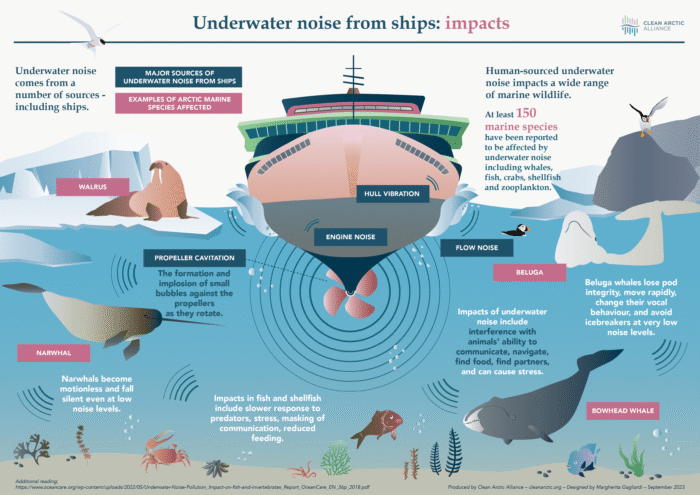
Ocean noise is a complex blend of natural and anthropogenic sounds that shape the underwater world and influence marine ecosystems. Understanding and mitigating harmful noise is an active area of scientific research and conservation policy.
Ocean noise can be categorized into the following two categories:
- Natural Ocean Sounds:
- Waves and wind;
- Rain hitting the water;
- Earthquakes and underwater volcanoes; and
- Animals like whales, dolphins, and shrimp (some shrimps are surprisingly loud).
- Human-Made Ocean Noise:
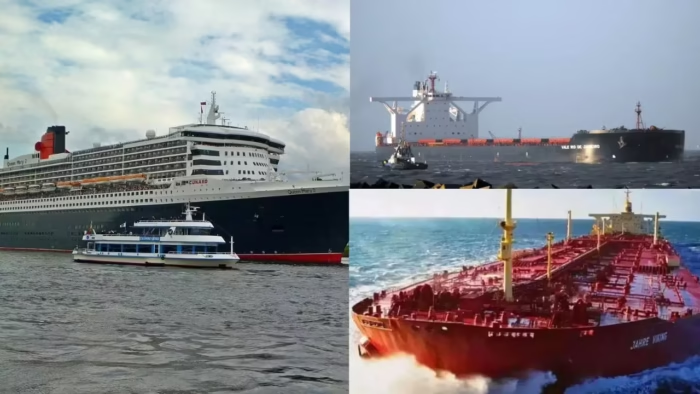
- Ships and boat engines;
- Sonar used by ships and submarines;
- Offshore drilling and construction; and
- Seismic surveys for oil and gas.
Ocean noise directly interferes with marine life and it is important to appreciate the fact that marine animals depend on noise to:
- Communicate;
- Find food;
- Navigate; and
- Avoid danger.
Here is a fact – Too much human-made noise can:
- Stress animals;
- Disrupt communication (Especially whales);
- Cause animals to change migration routes; and
- In extreme cases, it leads to injury.
Unfortunately, human-made noise is increasing and can travel hundreds of kilometers underwater and it is critical to understand the impact of noises on marine life, which has become an environmental issue.

Marine life refers to all the plants, animals, and microorganisms (A microscopic organism, especially a bacterium, virus, or fungus.) that live in oceans and here is a brief description of groups of marine life:
- Plankton – Tiny drifting organisms;
- Phytoplankton (Plant-like) make much of Earth’s oxygen;
- Zooplankton are small animals that many fish eat;
- Invertebrates – Animals without backbones, like jellyfish, corals, starfish, crabs, and octopuses;
- Fish – From tiny reef fish to sharks and rays;
- Marine reptiles – Sea turtles and sea snakes;
- Marine mammals – Whales, dolphins, seals, sea lions, and manatees; and
- Marine plants and algae – Seaweeds (like kelp) and seagrasses that provide food and shelter.
It is critical to comprehend why marine life matters, it:
- Produces oxygen and absorbs carbon dioxide;
- Supports food webs and fisheries;
- Protects coastlines; and
- Inspires medicine and technology.
It was reported that:
- Ocean noise in Canada, is a significant environmental issue, driven by human activities that impact marine life, prompting the government to develop strategies for mitigation and management. It is a well known fact that Canada has the world’s longest coastline and three major marine regions, and these waters support sensitive and endangered species that rely on ocean noise:
- Pacific Ocean;
- Atlantic Ocean; and
- The Arctic Ocean.
Specifies of concern for Canada includes:
- Southern Resident Killer Whales (BC) – critically endangered, ship noise interferes with feeding and communication;
- North Atlantic Right Whales – Ship noise and strikes are major threats;
- Beluga whales (St. Lawrence & Arctic) – affected by shipping and industrial activity; and
- Seals, fish, and invertebrates are also impacted (stress, habitat avoidance).
Canada is considered a global leader on this issue, and the following key actions are being taken to live up with the reputation:
- Oceans Protection Plan (OPP) – includes noise reduction initiatives;
- Vessel slowdowns in key whale habitats;
- Seasonal shipping restrictions;
- Quiet vessel design incentives;
- Marine Protected Areas (MPAs) with noise considerations; and
- Research led by Fisheries and Oceans Canada (DFO).
Canada is active in the International Maritime Organization (IMO) on global ship-noise guidelines and Collaboration with Indigenous communities and scientists. Nevertheless, it is faced with arctic-specific concerns as:
- Rapidly increasing ship traffic due to melting sea ice;
- Marine mammals there evolved in historically quiet environments; and
- Noise overlaps with climate change, making impacts more severe
Canada is also faced with the following ongoing challenges:
- Noise is invisible and hard to regulate;
- Economic reliance on shipping and resource extraction; and
- Limited long-term acoustic monitoring in some regions
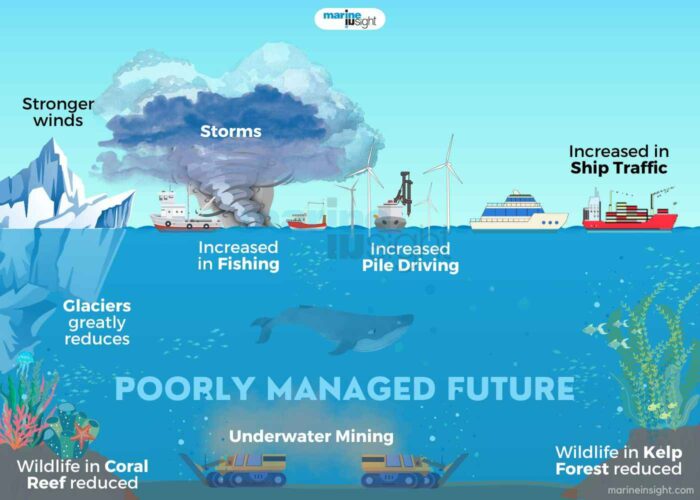
From an international point of view, countries, scientists, NGOs and international bodies are increasingly recognizing ocean noise pollution — the rising tide of human-made sound beneath the waves — as a serious global environmental issue and taking a variety of steps to measure, reduce and regulate it. Sound travels farther and faster in water than in air, so noise from ships, oil and gas exploration, construction, and sonar can disrupt marine life that depends on sound for communication, navigation and feeding.
The underwater noise produced from global commercial shipping poses a significant threat to the entire ocean ecosystem, including aquatic plants, plankton, invertebrates, fish, and marine mammals. To address this issue, the International Maritime Organization (IMO) first developed voluntary underwater noise reduction guidelines in 2014. Unfortunately, due to the guidelines being voluntary, large-scale uptake from industry was minimal. In 2023, the IMO released a revised set of guidelines which includes a three-year Experience-Building Phase and Action Plan to raise industry awareness, share best practices, and develop methods for underwater noise reduction.
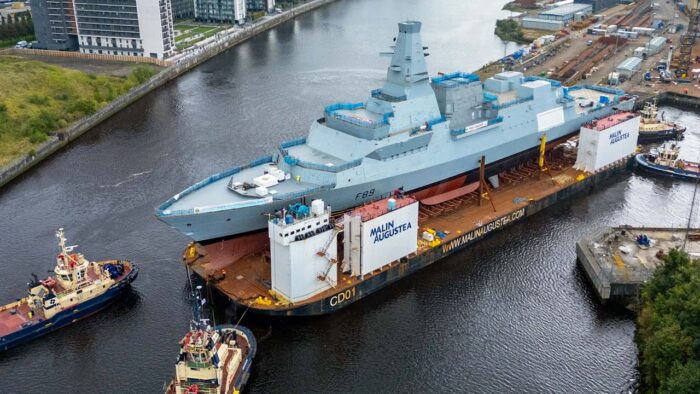
Noise reduction technology implemented at the ship design and construction phase and speed reduction measures are essential in advancing international efforts to reduce underwater shipping noise. At the IMO, EIA (Energy Information Administration) proactively engages with member-states to promote adoption of mandatory global regulations for reducing underwater noise. This is especially critical within Arctic waters, where the marine soundscape is currently less personified by continuous vessel noise, compared to other more industrialized areas of ocean.
Ocean noise has been brought into the broader by United Nations and Sustainable Development agenda of ocean health at forums like the 2025 United Nations Ocean Conference, which seeks ocean conservation action against multiple threats (though noise is one of many issues discussed).
Unfortunately, while progress is being made, many experts and conservationists argue that current measures are still not yet sufficient to significantly reduce ocean noise at the scale needed for many marine species — especially in rapidly changing regions like the Arctic.
Regrettably, there is no single country that clearly stands alone as “The world leader” in controlling ocean noise—because the issue is still emerging globally and mainly tackled through regional cooperation and international partnerships rather than strict national laws. However, based on recent developments, a few stand out for leading political and regulatory efforts:
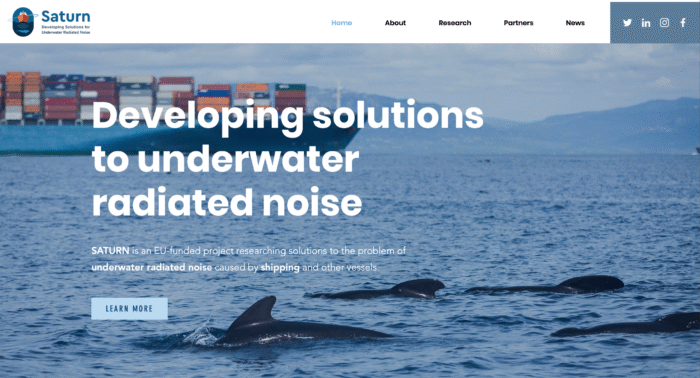
- In 2024–2025, the European Commission introduced the world’s first mandatory underwater noise limits that all 27 EU member states must adopt into national law to reduce noise from human activities at sea. This goes beyond voluntary guidance and requires noise monitoring and management in EU waters. This EU move is widely seen as the most concrete regulatory step globally toward controlling ocean noise;
- Canada has taken a strong political leadership role internationally by co-founding the High Ambition Coalition for a Quiet Ocean alongside Panama and 35 other countries. This coalition — established at the 2025 United Nations Ocean Conference — represents nations committed to reducing ocean noise and advancing quieter ship design and operational measures worldwide;
- The International Maritime Organization (IMO) isn’t a country, but its role is crucial because it regulates international shipping — the largest source of ocean noise:
- It has updated global guidelines for quieter ship design and has launched a Global Partnership (GloNoise) to pilot implementation in several countries;
- This effort helps countries adopt best practices and harmonize approaches; and
- Even though IMO guidelines are voluntary for now, they are the most widely recognized international standard and form the backbone of how nations approach underwater noise; and
- South Africa is emerging as an early adopter of domestic noise regulation under environmental and marine conservation laws, highlighting efforts to regulate underwater noise within its waters and integrate noise into shipping and impact assessments.

The coalition launched in 2025 includes the EU, Canada, Panama and many others — together representing a large share of the global shipping fleet — showing collective leadership rather than dominance by one state.
Here’s the reality check; Ocean noise is now recognized not just as an environmental issue, but as a biodiversity, cultural, and governance issue.
Here is a short video for your browse: Ocean Noise.
