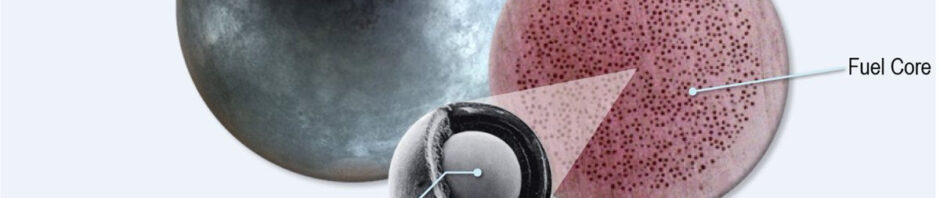

TRISO stands for TRIstructural-ISOtropic fuel. It’s an advanced type of nuclear fuel designed to provide enhanced safety, high-temperature tolerance, and robust containment of fission products.
The TRISO fuel consists of small spherical fuel particles encased in layers of protective materials. The fuel kernel, which contains uranium or thorium, is coated with layers of carbon and ceramic materials. These layers include:
- The fuel kernel (usually uranium or thorium) at the center;
- A buffer layer that absorbs radiation damage;
- A silicon carbide (SiC) layer that acts as a robust containment barrier for fission products; and
- A pyrolytic carbon outer layer that helps maintain the integrity of the fuel under high temperatures.
TRISO fuel was developed in the 1960s as part of research into high-temperature nuclear reactors. The U.S. Atomic Energy Commission and various national laboratories began experimenting with TRISO fuel to enhance the safety and efficiency of nuclear reactors.
The use of TRISO fuel is still in its developmental phase for most of these applications, but its future looks promising, especially with the growing interest in safer, more efficient nuclear power and space exploration.
The development of TRISO fuel was part of broader research into gas-cooled reactors, which aimed to build reactors capable of operating at higher temperatures than conventional water-cooled reactors. This was important for improving thermal efficiency and reducing risks in the event of an accident.
- TIMELINE AND HISTORICAL BACKGROUND:
- 1960s-1970s: Early development of TRISO fuel as part of research into high-temperature gas reactors (HTGRs). In these years, several nuclear laboratories, including the Oak Ridge National Laboratory and the Idaho National Laboratory, played pivotal roles in testing and refining TRISO technology.
- 1980s: The TRISO fuel concept was further improved for use in experimental reactors. The U.S. and other countries began developing reactors like the High-Temperature Gas-cooled Reactor (HTGR) to utilize these types of fuel. However, widespread deployment was delayed as nuclear power faced competition from cheaper energy sources, and concerns over safety and nuclear waste management arose.
- 2000s-Present: In recent decades, interest in TRISO fuel has surged again, especially as global concerns over climate change and the need for cleaner energy solutions have brought nuclear power back into focus. TRISO fuel is seen as an integral part of the Generation IV reactors, which aim to be safer and more efficient than existing reactors. The U.S. Department of Energy (DOE) and other international organizations are actively funding projects to commercialize TRISO fuel for new reactors.
- Space Exploration: The potential for TRISO fuel in space exploration became more prominent in the 2010s, with NASA and other space agencies considering it for future missions to Mars and beyond, where traditional propulsion systems might not be efficient enough.
- MAIN USES OF TRISO NUCLEAR FUEL:
- Nuclear Power Generation: TRISO fuel is primarily used in advanced nuclear reactors, including high-temperature gas-cooled reactors (HTGRs) and gas-cooled fast reactors (GFRs). It can also be used in experimental reactors that aim to demonstrate the potential of Generation IV reactors;
- Safety and High Efficiency: TRISO fuel is known for its high thermal stability and ability to withstand high temperatures, which makes it ideal for next-generation nuclear reactors. The design of the fuel allows it to contain fission products very effectively, even in extreme conditions, making it a safer option compared to traditional fuel types;
- Space Applications: TRISO fuel has also been proposed for use in nuclear thermal propulsion systems for spacecraft, particularly for long-term missions. The compact and durable nature of TRISO fuel is beneficial in space, where efficiency and reliability are paramount; and
- Reduction of Nuclear Waste: The design of TRISO fuel minimizes the release of radioactive materials, leading to a cleaner nuclear energy cycle and potentially lower levels of nuclear waste, especially when combined with advanced reprocessing techniques.
- ADVANTAGES:
- Improved safety margins compared to conventional UO₂ fuel;
- Can survive loss-of-coolant accidents without melting; and
- Minimal release of fission products in extreme conditions.
- DISADVANGES:
- Fabrication Complexity: Multi-layered coatings are technically demanding and expensive to produce;
- Scale-up: Manufacturing large quantities for commercial reactors is challenging; and
- Waste Management: While fission products are contained, TRISO fuel is more difficult to reprocess than conventional fuel.
TRISO Nuclear Fuel is being actively developed and tested by several organizations and research institutions, with both government agencies and private companies involved. The primary users of TRISO fuel at this stage are those engaged in advanced nuclear reactor development, space exploration missions, and nuclear fuel research.
Here is a list of organizations where TRISO is being tested:
- GOVERNMENT AGENCIES: Several national laboratories and government agencies around the world are leading the development and testing of TRISO fuel:
- United States Department of Energy (DOE): The DOE, through its national laboratories, has been at the forefront of TRISO fuel research and development, particularly at the Idaho National Laboratory (INL) and Oak Ridge National Laboratory (ORNL). The DOE is funding various projects to advance the commercial use of TRISO fuel, including its application in high-temperature gas reactors (HTGRs) and next-generation reactors;
- U.S. National Aeronautics and Space Administration (NASA): NASA is exploring the use of TRISO fuel for nuclear thermal propulsion (NTP) systems for space missions, including missions to Mars and other deep-space destinations. The durability and compact nature of TRISO fuel are crucial for the demanding environment of space;
- International Atomic Energy Agency (IAEA): While not directly using the fuel, the IAEA has supported research into advanced reactor designs, including those that might use TRISO fuel. They promote international collaboration on the development of safer, more efficient nuclear technologies;
- China National Nuclear Corporation (CNNC): China has been actively researching and developing advanced reactors, including the High-Temperature Gas-Cooled Reactor (HTGR), and has been investigating the use of TRISO fuel in these reactors. The Chinese have shown interest in deploying reactors using TRISO fuel for both power generation and for industrial heat applications; and
- Russian State Atomic Energy Corporation (Rosatom): Russia has shown interest in high-temperature gas reactors and advanced nuclear technologies, including those that might incorporate TRISO fuel for better safety and efficiency.
- PRIATE COMPANIES: A number of private companies in the nuclear energy sector are also pursuing the use of TRISO fuel, either in collaboration with government agencies or independently. Some of these companies include:
- X-energy: This U.S.-based company is actively developing the Xe-100, a small modular reactor (SMR) that uses TRISO fuel. The Xe-100 reactor is designed to be a safer, more efficient, and versatile power source, leveraging TRISO fuel’s ability to withstand higher temperatures. The company is working to commercialize its reactor design and has been involved in various funding programs with the U.S. Department of Energy;
- TerraPower: Although primarily focused on developing the Natrium reactor (a sodium-cooled fast reactor), TerraPower has also shown interest in the potential of TRISO fuel in the future, especially as part of advanced reactor concepts;
- Kairos Power: Another company based in the U.S., Kairos Power is working on the Kairos Power Reactor (KPR), a reactor that uses molten salt as a coolant and potentially integrates TRISO fuel. This company is looking to commercialize reactors that can provide clean, affordable, and safe nuclear power; and
- Copenhagen Atomics: A Danish startup that has been exploring advanced nuclear reactor technologies, including the use of TRISO fuel, in its Molten Salt Reactor designs.
- NUCLEAR REACTOR OPERATORS: While the use of TRISO fuel in commercial reactors is not widespread yet, some existing nuclear reactor operators are also exploring its potential for next-generation reactors. For example:
- High-Temperature Gas-Cooled Reactors (HTGRs): Countries like Germany, South Korea, and Japan have explored or are developing HTGRs that could potentially use TRISO fuel, owing to its higher thermal efficiency and inherent safety advantages; and
- Modular Reactors: The development of small modular reactors (SMRs) that use TRISO fuel is gaining traction, particularly in countries like the U.S., Canada, and the U.K. These reactors are designed to be safer and more adaptable for smaller-scale energy needs.
- SPACE EXPLORATION AGENCIES AND CONTRAS:
- NASA and Private Space Companies: As mentioned earlier, NASA is exploring TRISO fuel for its nuclear thermal propulsion systems for future space missions. Companies like Blue Origin and SpaceX may also eventually benefit from TRISO-based propulsion systems for their spacecraft. Although these projects are still in the research and testing phase, the potential use of TRISO in space exploration is becoming more likely.
REFERENCES:
- U.S. Department of Energy (DOE). (2021). “TRISO Fuel Development.” Retrieved from www.energy.gov;
- NASA. (2021). “Nuclear Thermal Propulsion.” Retrieved from www.nasa.gov;
- Idaho National Laboratory (INL). (2020). “TRISO Fuel: A Safer, More Efficient Nuclear Fuel.” Retrieved from www.inl.gov;
- X-energy. (2021). “The Xe-100: A High-Temperature Gas Reactor Using TRISO Fuel.” Retrieved from www.x-energy.com; and
- China National Nuclear Corporation (CNNC). (2020). “HTGR Development with TRISO Fuel.” Retrieved from www.cnnc.com.cn and
- International Atomic Energy Agency (IAEA). (2020). “Advanced Nuclear Fuel Cycles and Radioactive Waste Management.” Retrieved from www.iaea.org.
